

23 Oct 2026 · Buyer guides
Planning a Ceramic Knife Range for 2026: What Buyers Ask For
Range planning for ceramic knives is usually done from a catalogue rather than from demand. The result is a wide, shallow offer: forty SKUs, no story, and stock that ages.
This is what distributors and brand owners are actually asking for when they brief a supplier — and how to turn that into a first range that sells.
What buyers ask for now
- Fewer colours, done properly. Two or three colourways that can be replenished beat eight that run out.
- Retail-ready packaging. Buyers increasingly refuse to repack. The box has to arrive shelf-ready, with a barcode and care instructions.
- Compliance documents at quotation stage. A buyer who cannot get a test report before the order will not place it.
- Smaller opening orders. First orders are getting smaller and more frequent; the constraint is usually the packaging print run, not the knives.
- Black blades. Still the strongest differentiator on shelf, but batch-to-batch colour consistency is the usual complaint.
- Sets over single knives. A three-piece set with a peeler outsells the same knives sold separately in most gifting and housewares channels.
The categories, ranked by how easy they are to sell
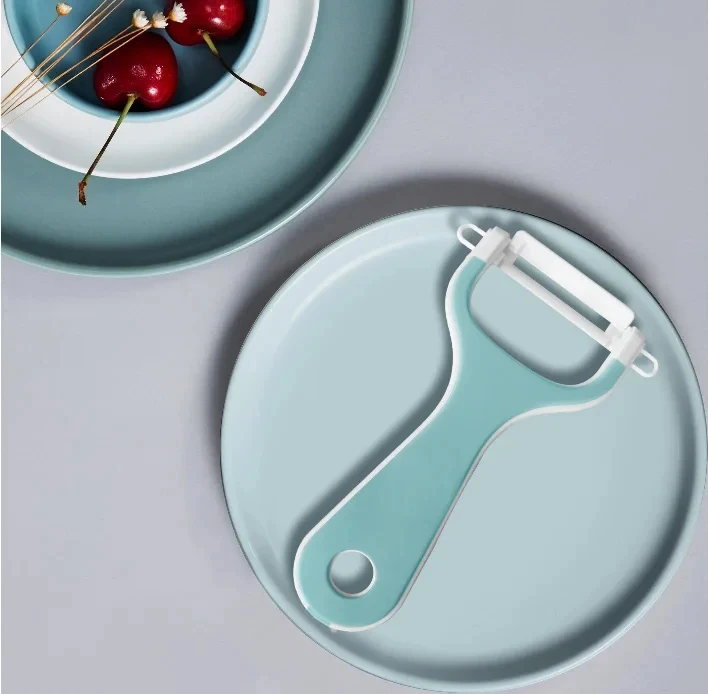
- Peelers — low price, high trial, strong repeat. Best entry SKU.
- Three-piece knife sets — the default gift purchase.
- Utility and paring knives — single-piece entry price.
- Food scissors and baby-food scissors — high attach rate in baby and kitchen channels.
- Baby tableware — a separate buyer, often a separate channel; needs its own compliance story.
- Utility cutters — a working tool, sold through hardware and packaging channels rather than housewares.
- Fishing tools — a niche with loyal buyers and less price pressure; not a volume category.
- Large cleavers and chef knives — range completeness, not lead items.
A first range that works
Six to eight SKUs is enough to open a market:
- One 3-piece set in two colourways.
- One paring or utility knife.
- One peeler.
- One food scissor.
- One baby-food scissor or feeding set, if the channel supports it.
- One “hero” SKU — a black-blade set or a gift-boxed set — for the top of the range.
This gives a price ladder (entry, core, gift) without forcing a packaging print run for every item.
Channel changes the answer
| Channel | What sells | What to avoid |
|---|---|---|
| Gift / department store | Sets, gift boxes, colour | Loose single knives |
| Housewares retail | Peelers, utility knives, sets | Too many colours |
| Online marketplace | Sets with strong photos, clear care instructions | Products that generate returns from misuse |
| Baby retail | Feeding sets, baby-food scissors | Knives in the same range |
| Hardware / industrial | Utility cutters, replacement blades | Gift packaging |
Pricing architecture
Three tiers, three jobs:
- Entry — a peeler or paring knife, priced to be tried.
- Core — the 3-piece set, where the margin lives.
- Gift — boxed set with a stand or a premium colour, priced for occasions.
Ceramic discounts badly, so the gift tier should add value (packaging, a stand, a matching peeler) rather than a discount.
What to avoid
- Colour proliferation. Every colour is a masterbatch minimum and a stock-keeping problem.
- Novelty shapes. They photograph well and sell once.
- Unverified claims. “Never needs sharpening” and “unbreakable” generate returns and complaints; “retains its edge far longer than steel” does not.
- SKUs without packaging. A model that cannot be sold retail is a warehouse item.
The calendar nobody plans for
- Chinese New Year — production stops for 2–4 weeks. Orders that need to land before a spring season must be placed by early December.
- Q4 gifting — goods need to be in the market by September; production and sea freight mean ordering in June.
- Samples — always add two weeks to whatever the supplier quotes, especially around holidays.
The short version
A good first range is narrow, colour-disciplined and packaging-ready. Pick six SKUs that cover entry, core and gift, confirm the documents before you order, and leave the long tail for the second season.
Related reading: what can be customised and what it costs in MOQ · the 12-point QC plan · where the retail margin comes from.
Sourcing ceramic tools?
Send the models, target market and quantity and we will come back with a configuration and a quotation.