

23 Oct 2026 · Buyer guides
QC for Ceramic Knives: 12 Checks That Catch the Problems Buyers Complain About
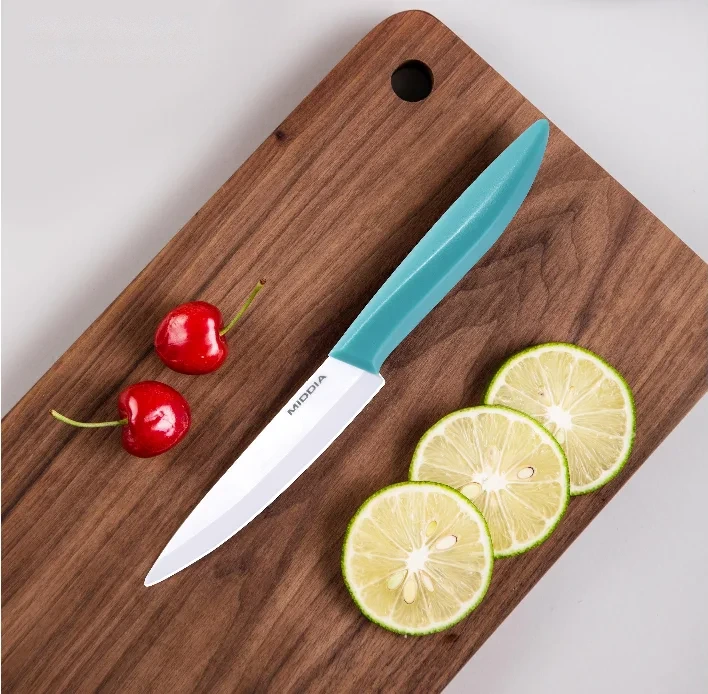
Ceramic knives fail differently from steel. They do not bend or rust; they chip, crack, and come loose from the handle. That changes what a quality inspection should look at.
This is the inspection plan we would use on a ceramic knife order, written so it can be handed to a QC team or a third-party inspection company.
Before production: the golden sample
Every check below needs a reference. Approve a physical golden sample and keep a signed copy with both parties. It should record:
- Blade colour and surface finish.
- Handle colour against a Pantone reference.
- Marking position and method.
- Packaging, insert and labelling.
Without a golden sample, “the colour is wrong” is an opinion, not a defect.
The 12 checks
1. Blade chips and cracks
Inspect the full edge and both faces under a 10× loupe. Look for micro-chips at the edge, hairline cracks near the handle joint, and glaze pinholes on the flat. A chip smaller than 0.5 mm is still a chip on a cutting edge.
2. Edge sharpness
Cut a ripe tomato and a sheet of 80 gsm paper in one continuous stroke. The blade should bite without pressure and not tear the paper. Do this on a sample of pieces, not one.
3. Blade-to-handle bond
Clamp the handle and pull the blade with a spring scale to the agreed force. Most failures show up as movement rather than separation — check for any play at the joint before and after the pull.
4. Handle colour
Measure with a colourimeter against the golden sample and record ΔE. ΔE ≤ 2 acceptable, 2–3 borderline, above 3 reject. Check under D65 lighting, not factory fluorescents.
5. Handle surface
Look for flash at the parting line, sink marks, scratches and polishing swirl. Run a fingernail along the seam — if it catches, the customer will feel it.
6. Blade colour consistency
Black blades vary between batches more than white. Line up ten pieces side by side under the same light; any that read as a different shade should be separated.
7. Marking adhesion
Apply 3M 610 tape over the logo, press, and pull at 45°. No transfer. Then run 20 dishwasher cycles (65 °C, standard detergent) and repeat. Marking that survives tape but not the dishwasher is a return waiting to happen.
8. Dimensions and weight
Measure blade length, overall length and handle thickness against the spec. Weigh ten pieces: a spread above about 5% suggests inconsistent blade thickness or handle density.
9. Drop test — packaged
Drop the retail-packed unit from 1 m onto a hard floor, on each of three axes. Inspect blade, handle and box. This is the test that predicts parcel-network damage; do it before the carton test.
10. Carton drop and compression
Drop the export carton from the height your freight forwarder uses (typically 60–80 cm for a 15–20 kg carton), then open and inspect. Stack test if the cartons will be palletised and double-stacked.
11. Packaging and labelling
Barcode scannable, country of origin, material marking, care instructions, importer details where required, and artwork matching the approved proof. Check the insert actually holds the knife — a loose knife in a box is a defect even if the box is intact.
12. Function of mechanisms
For peelers: blade rotation, smooth swivel, no wobble. For scissors: action through the full stroke, no binding, spring return. For retractable cutters: lock and release, blade play.
Sampling and AQL
Use ISO 2859-1 general inspection level II as a default:
- Major defects (chipped edge, loose blade, wrong colour, broken packaging): AQL 2.5.
- Minor defects (light polish marks, label skew): AQL 4.0.
- Critical: any safety issue, zero tolerance.
Define these categories in the PO. “Major” is where most disputes start.
When to inspect
Two points matter: during production (to catch a trend before 5,000 pieces are made) and pre-shipment, after packing. A final inspection on unpacked goods misses the packaging failures that cause most transit damage.
Evidence that is actually useful
Ask for photos with the defect circled and a scale reference, a short video of the sharpness and drop tests, and the measurement sheet. A report that says “quality good” is not evidence.
The short version
Ceramic knives pass or fail on the edge, the joint, the colour and the packaging. Inspect those four properly and you will catch nearly everything a customer would have complained about.
Sourcing ceramic tools?
Send the models, target market and quantity and we will come back with a configuration and a quotation.