

22 Oct 2026 · Buyer guides
Private Label Ceramic Knives: What Can Be Customised, What Can’t, and What It Costs in MOQ
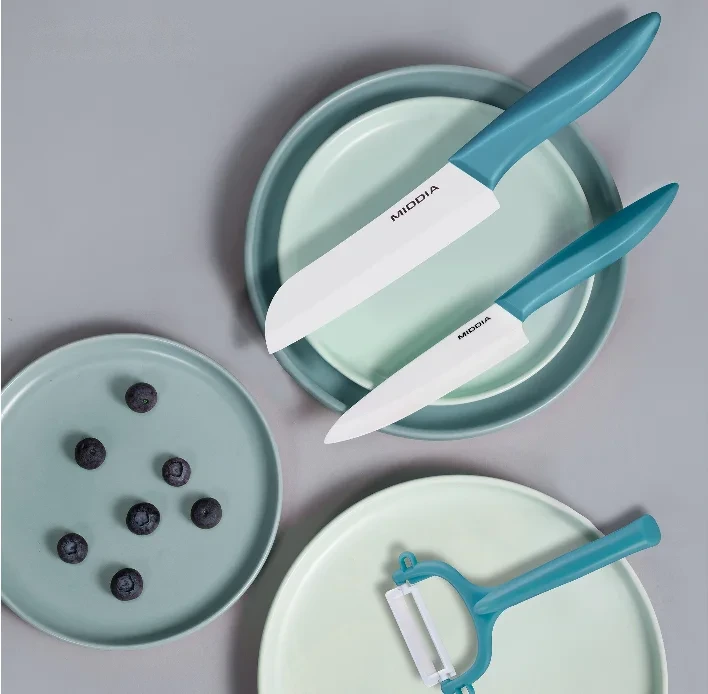
Most ceramic knife ranges are not designed from scratch. They are existing catalog models, re-coloured, re-branded and re-packaged for a specific market. That is what makes private label in this category fast — and what makes the MOQ conversation confusing, because every element has its own minimum.
Here is what can actually be changed, what cannot, and where the cost sits.
The starting point: existing tooling
Blade shape, blade length and handle mould are already tooled on a catalog model. Changing any of them means a new mould: tooling cost, 30–60 days of development, and a minimum in the thousands. Almost no first order justifies that.
Everything else — colour, marking, packaging, set composition — is a configuration change on an existing tool. That is the practical definition of private label here.
Handle colour: the real constraint
Colour is the most requested change and the one with the most predictable MOQ.
- Existing colourways — the colours already in the catalogue. No minimum beyond the model MOQ.
- Custom colour on an existing mould — requires a masterbatch. Typical minimum: 500–1,000 pcs per colour, sometimes per size.
- Colour matching — supply a Pantone reference, not a photo. Photos lie under different lighting and screens.
Agree a ΔE tolerance in writing. ΔE ≤ 2 is a reasonable production target for moulded plastic; above 3 the difference is visible side by side.
Blade marking: possible, with limits
Marking a ceramic blade is not like printing steel.
- Pad printing works, but the ink sits on a very hard, non-porous surface. Adhesion depends on pre-treatment and can wear with heavy dishwasher use.
- Laser marking gives a more durable mark, usually a light grey tone on white blades. On black blades the contrast is lower.
- Position is usually the flat of the blade near the spine, away from the edge — marking near the edge risks micro-chipping.
Ask for a marked sample and put it through 20 dishwasher cycles before approving. A mark that disappears in three months is worse than no mark.
Packaging: usually the biggest MOQ
Print runs are often the binding constraint, not the knives.
| Format | Typical minimum | Notes |
|---|---|---|
| Colour box (custom print) | 1,000–3,000 pcs | Corrugated or greyboard + print; dieline approval needed |
| Blister card | 1,000–3,000 pcs | Requires a sealing die; artwork on card only |
| Stock box + label | Model MOQ | Fastest and cheapest for a first order |
| Set with insert | Insert tooling + 1,000+ | Insert design affects damage rate |
Two details decide whether the packaging works: whether the knife is immobilised inside the box, and whether the box survives a 1 m drop. Ask for both before print approval.
Set composition: the cheapest way to differentiate
You can build a set from existing models — a santoku, a utility knife and a peeler — without new tooling. What changes is the insert and the box.
This is often the best first private-label project: it looks like a new product, uses existing components, and the only new cost is the insert and the print run.
What cannot be changed (practically)
- Blade geometry, thickness or edge angle — new tooling.
- Handle shape — new mould.
- Blade material grade — tied to the factory’s process.
- Ceramic blade colour other than white or black — pigments affect sintering.
The MOQ maths most buyers miss
A quote of “1,000 pcs” often decomposes into:
- 1,000 knives (model MOQ)
- 1,000 boxes (print run minimum)
- 1,000 pcs of one colour (masterbatch minimum)
If you want two colours, the knife quantity may double even though the model minimum did not change. Ask for the MOQ per component, then design the order around the largest one.
Timeline, realistically
Typical sequence for an existing model with custom colour and printed box: sample in 7–10 days, artwork and dieline approval 3–5 days, production 25–35 days after approval, plus shipping. New tooling adds 30–60 days. Treat these as ranges and confirm them for your specific configuration — they move with factory load and Chinese New Year.
Five mistakes worth avoiding
- Approving colour from a phone photo instead of a physical sample under daylight.
- Sending artwork without the dieline, then discovering the logo sits on a fold.
- Ordering packaging before the knife colour is locked.
- Forgetting the barcode and the destination-market labelling requirements.
- Approving a marked sample without a dishwasher test.
The pattern is consistent: private label in ceramic knives is a configuration exercise, and the risk sits in the details of colour, marking and packaging — not in the blade.
Sourcing ceramic tools?
Send the models, target market and quantity and we will come back with a configuration and a quotation.