

23 Oct 2026 · Buyer guides
Why Ceramic Knives Break in Transit — and the Packaging Fixes That Work
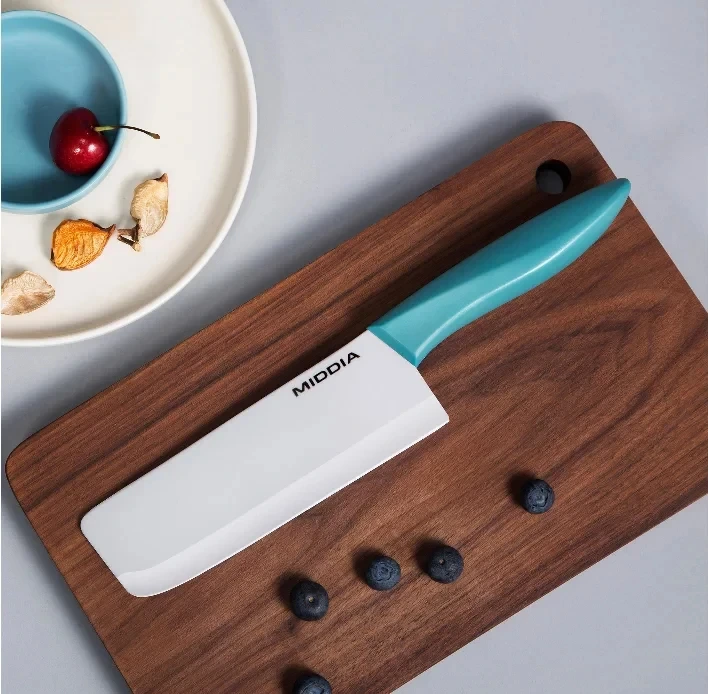
Ceramic knives do not fail in transit because the box is thin. They fail because the blade is allowed to move, or because a point load lands on an edge that cannot flex.
This is what actually breaks in a shipment, and the packaging changes that reduce it.
The five failure modes
| What you see | What happened |
|---|---|
| Chipped edge | Blade contacted the box wall, another knife, or the floor on a drop |
| Cracked handle | Point load on the handle end; carton compressed or dropped on a corner |
| Crushed retail box | Carton not strong enough for stacking; no internal void fill |
| Knife loose in box | Insert too shallow or missing; product rotated during transit |
| Scuffed print | Boxes rubbing against each other; no slip sheet or shrink wrap |
Almost all of these are decided at the packaging design stage, not by the carrier.
The hierarchy that matters
Protection works in layers, and the cheapest layer is the one closest to the blade:
- Blade guard or moulded insert. The knife must not be able to move in any direction. If you can shake the box and hear it, it will chip.
- Retail box. Needs a wall thickness that survives a 1 m drop with the product inside. A thin folding carton with no insert is a damage claim waiting to happen.
- Export carton. Double-wall (5-ply) for anything above ~12 kg. Single-wall is acceptable only for light, well-filled cartons.
- Pallet and stretch wrap. Prevents corner compression and stops cartons sliding.
Test the pack, not the knife
Run these before the first bulk order, and again if the box changes:
- 1 m drop, packaged, three axes — the basic retail-parcel test.
- Carton drop at 60–80 cm — the freight reality for a 15–20 kg carton.
- Compression — stack two pallets high for 24 hours if that is how it will be stored.
- Vibration — a parcel network is a vibrating environment; loose contents abrade and chip.
Open the pack after each test and inspect the blade under a loupe, not just the box.
Sea freight adds a problem land tests miss
Container humidity. A container crossing climates can produce condensation — “container rain” — which does not damage ceramic directly but ruins printed cartons and can leave water marks that make a perfect product look second-hand.
- Use desiccant bags for long sea routes, especially in summer.
- Keep cartons off the container floor with a pallet or slip sheet.
- Ask for a moisture-barrier liner on high-value shipments.
Parcel, LCL or FCL changes the design
- Parcel / courier — the harshest handling per unit. Every retail box must survive on its own; assume multiple drops and sorting-belt impacts.
- LCL — consolidation means your cartons are handled several times and stacked with other cargo. Stronger cartons and edge protection are worth the cost.
- FCL — the gentlest, but compression and humidity still apply.
The cost maths
Better packaging usually costs $0.05–$0.15 per unit. A damaged return costs the unit, the freight both ways, the customer service time, and often the review.
At a 3% damage rate on a $3.20 unit, you are losing roughly $0.10 per unit before you count the returns process. Upgrading the insert to remove that 3% is close to free.
Checklist before the first bulk shipment
- Insert holds the knife with zero movement.
- Blade edge is not in contact with any rigid surface.
- Retail box drop-tested at 1 m, three axes, with product inside.
- Carton is 5-ply for 12 kg+ and drop-tested at 60–80 cm.
- Cartons are strapped or shrink-wrapped to the pallet.
- Desiccant included for sea freight.
- Carton markings: this side up, fragile, gross weight, carton number.
- Photos of the packed carton and the pallet before it leaves the factory.
The short version
Ceramic knives arrive intact when the blade cannot move and the carton can take a corner drop. Both are cheap to design in and expensive to discover in a claim. Test the pack before you scale the order, not after.
Related reading: 12 QC checks before shipment · the 9-point sourcing checklist.
Sourcing ceramic tools?
Send the models, target market and quantity and we will come back with a configuration and a quotation.